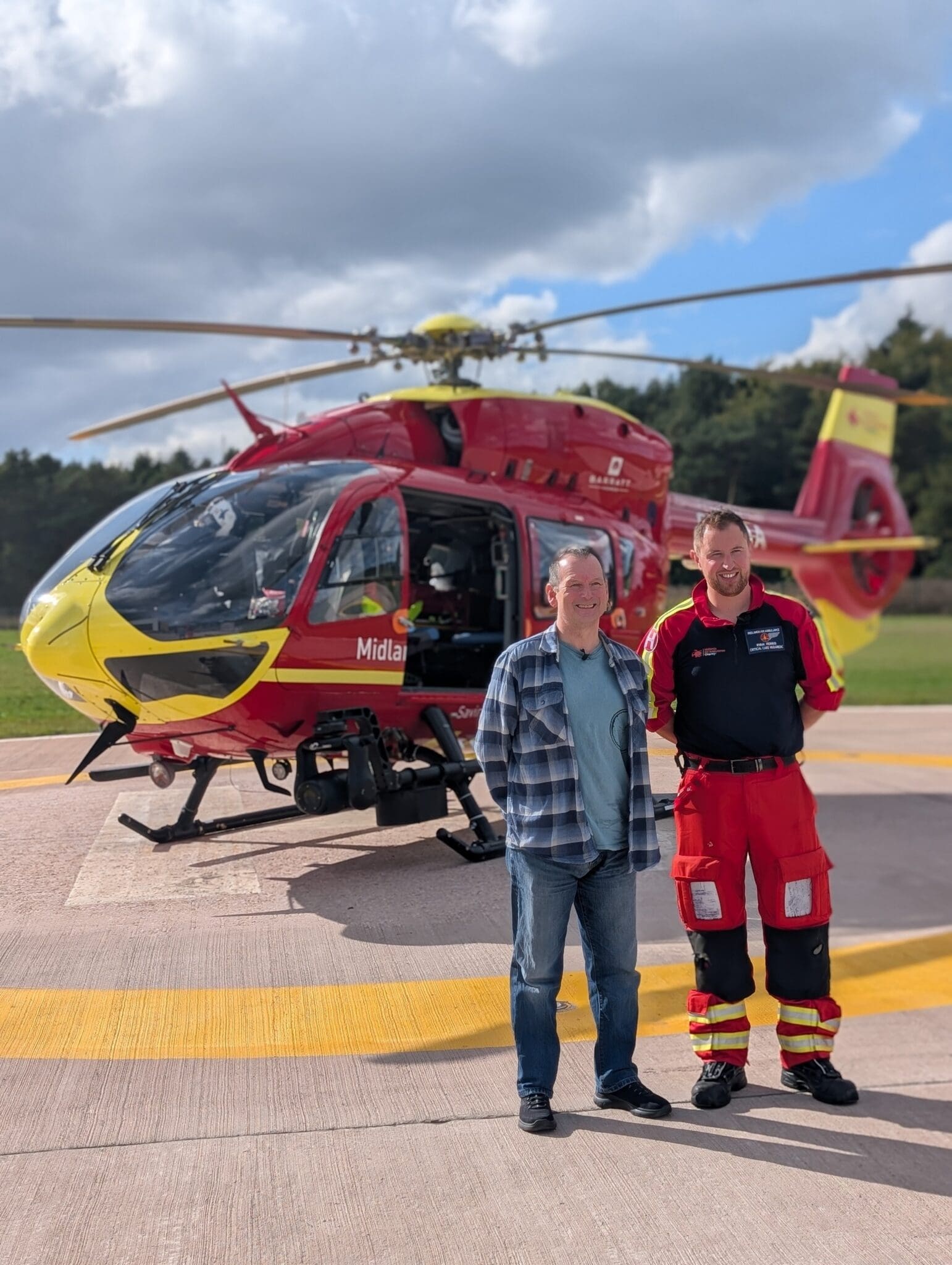
Kirk Williams, 50, remembers the split second when a routine off-road trail motorbike ride turned into a fight for his life.
Last autumn, while riding near Leek in Staffordshire, Kirk was thrown from his bike when he ran into a ditch. The exposed metal pedal caused a catastrophic injury to his groin. Unlike standard motorbike pedals, trail bike pedals are uncovered metal to provide better grip — making injuries like this particularly severe.
An ambulance was called immediately by a paramedic bystander who realised the seriousness of the situation. It was clear that time was of the essence.
Kirk said: “I remember realising that I’d lost control and that I was going to crash.”
Midlands Air Ambulance Charity’s critical care paramedics Rob Davies and Ian Roberts, alongside Dr James Mercer, were dispatched by air ambulance to the scene. They carried a vital resource – lifesaving blood. The average adult has around five litres of blood in their body and losing just two litres can be fatal.
When the air ambulance crew arrived, Kirk was already being attended to by a West Midlands Ambulance Service crew, Paramedic bystanders, and a Community First Responder. They had identified a severe arterial bleed and were working together to control the haemorrhage, using haemostatic gauze and applying firm pressure.
The incident demonstrated exceptional teamwork, decision making and improvisation from all emergency services on scene. Building on the care already being delivered, the Midlands Air Ambulance Charity crew tried hard to stop the bleeding and provided enhanced critical care including warmed fluids and blood products. A pre-hospital blood transfusion was administered – a decisive intervention that ultimately saved Kirk’s life.
Since 2017, Midlands Air Ambulance Charity has carried blood products on board its aircraft and critical care cars. Thanks to the expertise of our critical care paramedics and pre-hospital emergency medicine doctors, blood can be administered on-site.
Due to the severity of his injuries, Kirk was transported by land ambulance to Royal Stoke University Hospital, accompanied by the Midlands Air Ambulance crew who continued advanced care on route.
Critical care paramedic Ian Jones, said: “One of the biggest advantages in cases of significant blood loss like Kirk’s, is our capability to provide pre-hospital blood transfusions at the scene. This gives patients the best chance of survival, for Kirk, this ability was lifesaving.”
Kirk added: “I’m eternally grateful to everyone who helped me that day, especially the Midlands Air Ambulance Charity’s crew, because I’m acutely aware that their actions saved my life.”
Kirk is now making a full recovery and is hoping to get back on his bike once again. His story highlights the vital role of collaboration between bystanders, West Midlands Ambulance Service and Midlands Air Ambulance Charity. Without that seamless teamwork and the charity’s ability to deliver advanced, lifesaving care at the roadside – this outcome would not have been possible.