Emergency services in England treat nearly 40,000 people suffering out-of-hospital cardiac arrests each year.
Unfortunately, Wayne Bowring was one of them in June 2023 at his workplace in the West Midlands.
53-year-old Wayne was working as a body mechanic at A&R Vehicle Services in Wednesbury. On the day, he suddenly began to feel unwell, collapsed and went into cardiac arrest. His heart had stopped.
Four of Wayne’s work colleagues immediately responded to the situation by ringing 999 and administering vital bystander CPR. One of our charity’s critical care cars was rapidly dispatched to the scene with Colin Apps, a critical care paramedic, on-board.
When Colin arrived, Wayne was already being shocked with an AED (Automated External Defibrillator). Sadly, the survival rate of an out-of-hospital cardiac arrest is less than ten per cent. By receiving bystander support immediately before the arrival of the emergency services, the chances of survival can double or even triple.
I was what was known as ‘clinically dead’ as I was gone for more than five minutes,” said Wayne. “If it had not been for my work colleagues’ quick reactions, I might not have survived.”
Thanks to his work mates’ early intervention, Colin provided enhanced medicines and advanced treatment to Wayne. He cannulated Wayne and administered aspirin (helping to thin the blood and improve blood flow to the heart) and ondansetron (a medication used to prevent nausea and vomiting).
Morphine was also provided through the cannula to help widen the blood vessels to increase blood flow around Wayne’s body. In addition, glyceryl trinitrate (more commonly known as GTN spray) was sprayed under Wayne’s tongue to further relax and widen the blood vessels.
The combination of the initial CPR and AED shocks and critical care intervention from Colin meant that Wayne thankfully regained a pulse. He was transported to New Cross Hospital, accompanied by Colin in case Wayne rearrested and needed further advanced clinical treatment.
Wayne underwent open heart surgery in New Cross Hospital’s specialist cardiac unit and spent a week in the intensive care unit.
It was discovered that the cause of the cardiac arrest was due to Wayne being born with only two chambers in his heart instead of three. Wayne was fitted with a mechanical valve and a defibrillator on his back.
“Thank you to Colin, who went above and beyond and waited at the hospital until Wayne had come out of theatre reassuring me that he is going to be okay,” said Wayne’s wife, Melanie.
“He was so very kind and compassionate with me at a very stressful and scary time.”
Wayne returned home after four weeks in hospital to continue his recovery. Despite getting tired more quickly and taking a cocktail of tablets a day, Wayne’s recovery is steady but going well, and he was able to spend a lovely week in Tenerife.
He added: “I just thank God I am still alive and grateful for the second chance I was given.”
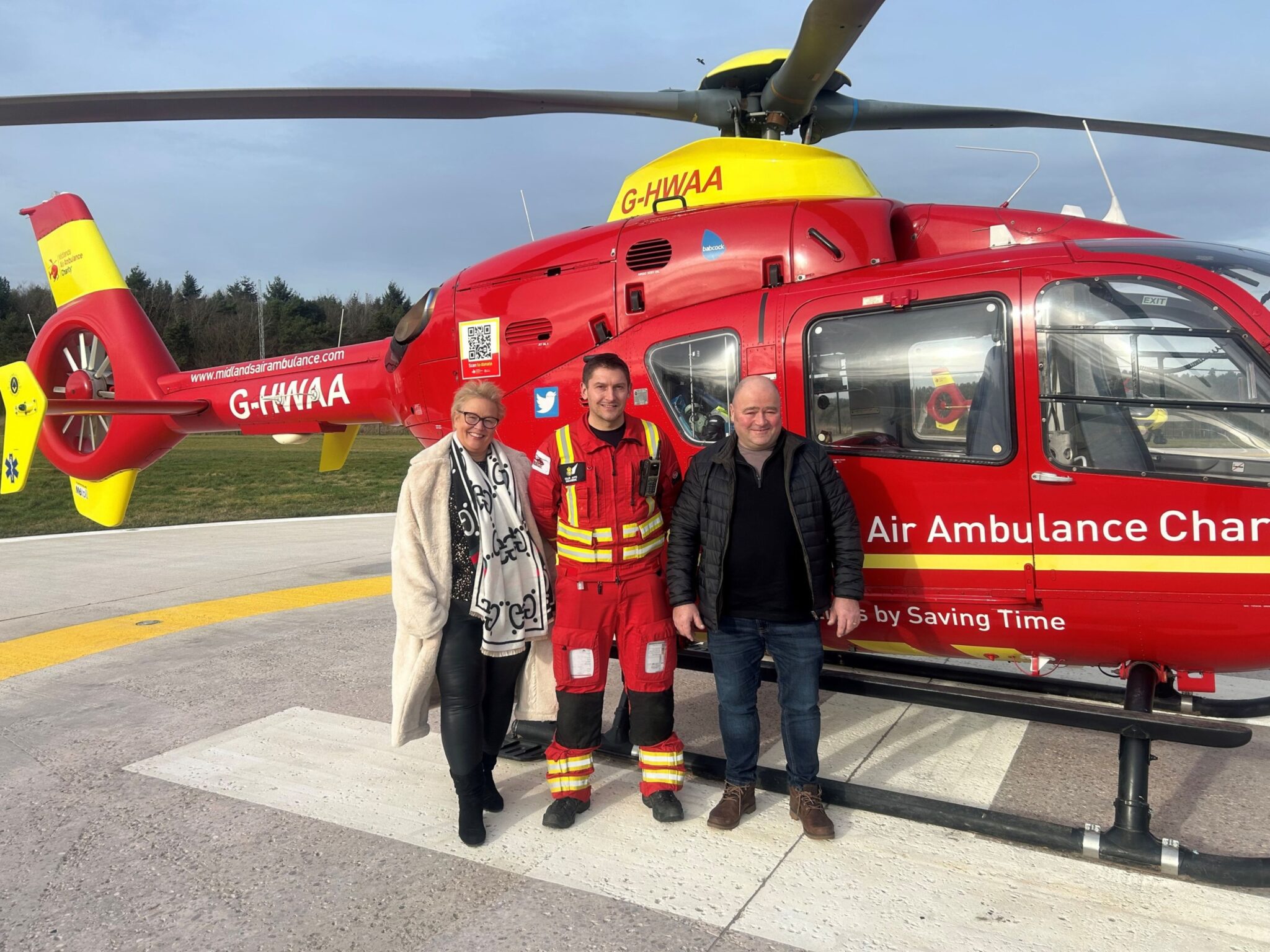
Wayne and Melanie visited our Cosford airbase and headquarters, where they met Colin for the first time since the incident and thanked him for his lifesaving support.
As part of their thanks to Colin and the charity, Melanie has kindly chosen Midlands Air Ambulance Charity as the charity of choice at her workplace.
Wayne said: “I want to thank my wife and two daughters, Laura and Tori, for being there for me along with some very good friends who continued to visit me whilst I was off work. You realise when something so serious happens who is there for you, and I will be eternally grateful for the support myself and Melanie were given.”